


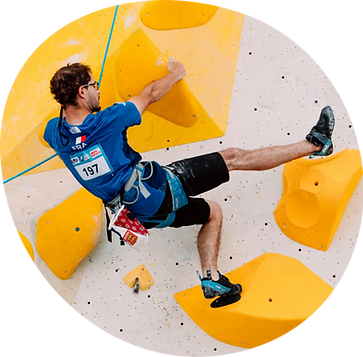

For many years, climbing has been practiced on cliffs, in the mountains, on boulders, or on artificial climbing structures by people with physical, mental, or sensory disabilities. It is called paraclimbing.
While climbing has been an Olympic sport since the Tokyo 2021 Games, para climbing will be included in the Paralympic Games in Los Angeles in 2028.
In competition, climbing is usually practiced in three different formats: bouldering, speed climbing, and lead climbing. For several years now, for practical and safety reasons, lead climbing has become the preferred format for para climbing competitions.
THE CIRCUIT
This year, 4 Para Series wil take place :
- Salt Lake City (USA) - may 15th and 16th
- Innsbruck (AUT) - june 15th and 16th
- Laval (FRA) - august 28th and 29th
- Gunsan (CHI) - octobre 31st and november 1st
CATEGORIES
Impairments can vary greatly, as can climbing levels. To ensure fair competition, athletes are ranked to compete with athletes with the same level of impairment. In para-climbing, there are currently 10 different categories.
.jpg)
B1 to B3
Athletes with visual impairment.
Athletes wear opaque masks and are accompanied by a guide in the competition area. They use handheld communication devices to communicate with each other.
AL1 or AL2
Athletes with lower limb impairment.
Wearing a prosthesis is left to the athlete's free choice.
.jpg)
.jpg)
RP1 to RP3
Athletes with limited strength and mobility.
.jpg)
To ensure a proper competition, the IFSC has defined a minimum number of athletes to open a category. Four athletes from three different countries are required to open a category in the World Cup, and six athletes from four different countries are required to open a category in the World Championship. If there are not enough athletes for a category, it is not opened and these athletes are not allowed to participate.
Since it is better to have an unfair competition than no competition, the rules provide the option to merge certain categories to allow more athletes to participate.

Source: paraclimbing.org
AU2 and AU3
Athletes with upper limb impairment.
In this category, the use of a prosthesis is prohibited.

The most prestigious event on the European calendar, the European Championship takes place every two years, in the three disciplines of competitive climbing (bouldering, lead and speed). After Villars-sur-Ollon (Switzerland), it is Laval's turn to welcome the best climbers on the continent, in lead and speed.
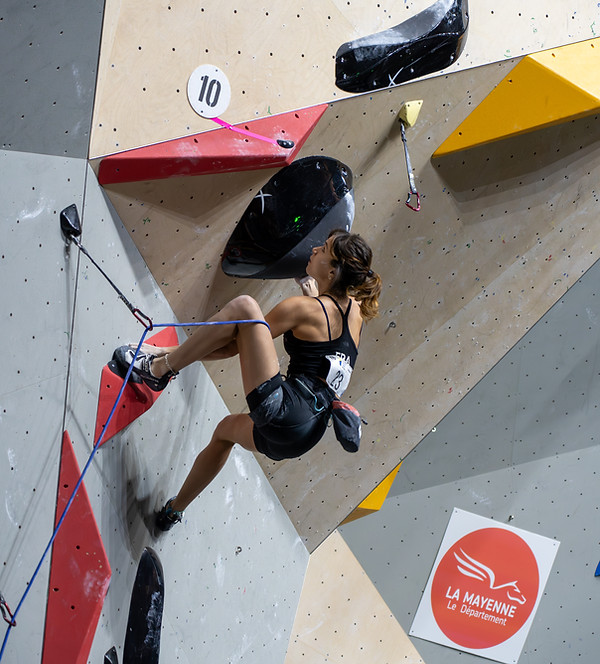
Lead is the original discipline of climbing, and is practiced with a harness and a rope. The goal is to reach the top of a route of increasing difficulty, on a wall with a maximum height of 16 meters. It requires strength, endurance, and determination
LEAD
REIGNING EUROPEAN CHAMPION - MEN
Sascha Lehmann (SUI)
REIGNING EUROPEAN CHAMPION - WOMEN
Laura Rogora (ITA)
Climbers set off on identical parallel routes. The fastest wins.
The objective of speed climbing is to reach the top of a 15m wall as quickly as possible. Men and women compete on identical routes, which remain unchanged between rounds. Competitors compete in pairs on identical routes. The winner is the first to reach the top of the route.
.jpg)
SPEED
WORLD RECORDS
MEN / 4.74s - Samuel Watson (USA)
WOMEN / 6.06s - Alexandra Miroslaw (POL)
EUROPEAN RECORDS
MEN / 4.74s - Samuel Watson (USA)
WOMEN / 6.06s - Alexandra Miroslaw (POL)